On-Line/Live Event
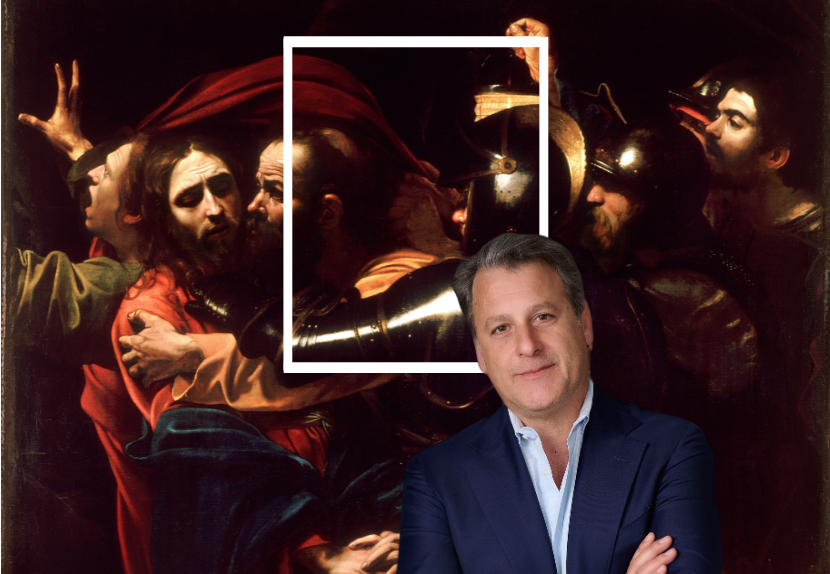
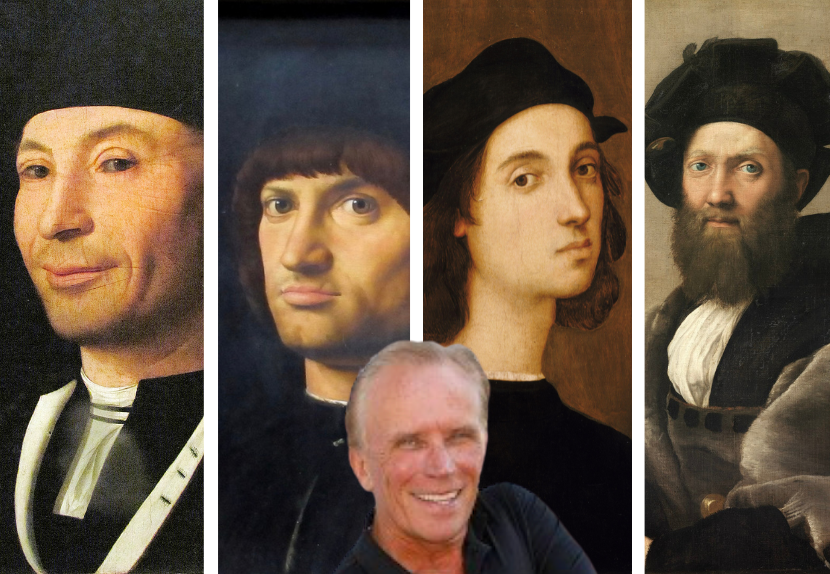
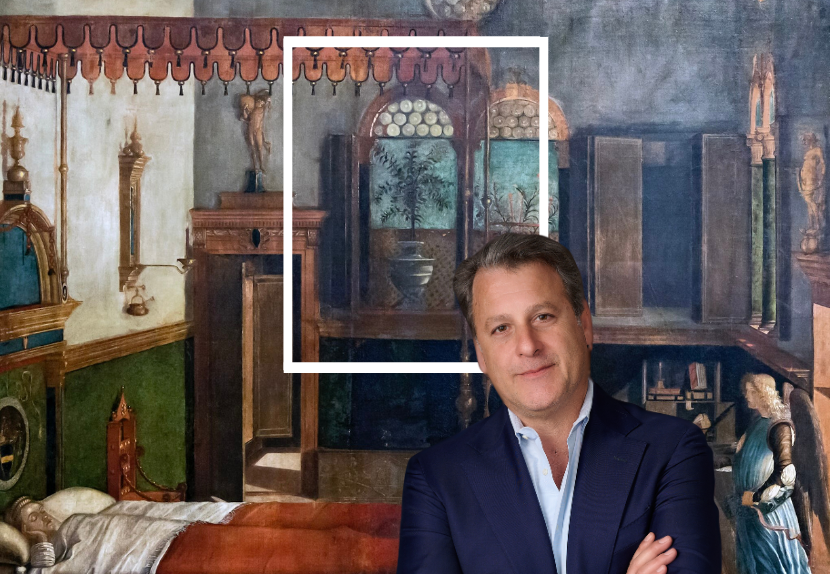
EXCLUSIVE WEBINAR | “Reading between the Brushstrokes: Imagery and Meaning in Italian Renaissance Painting” ...
March 26, 2026
1 hour
$25.00
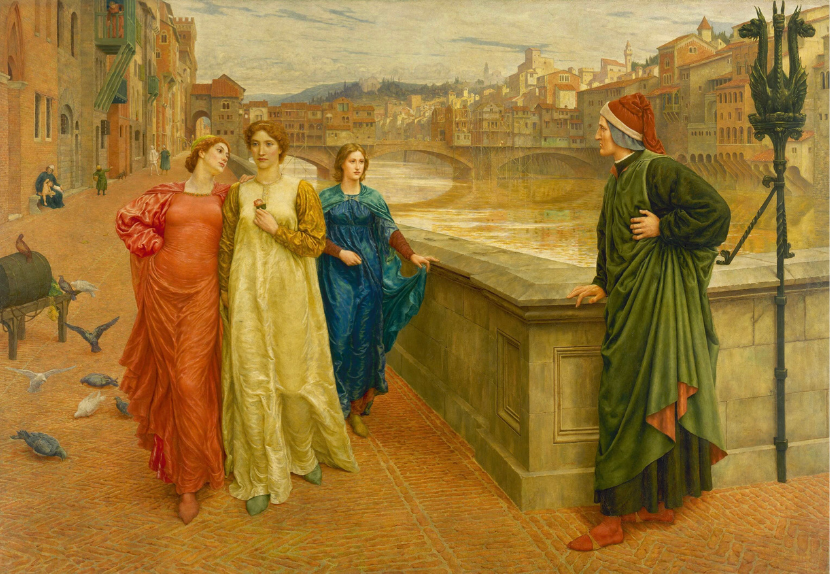
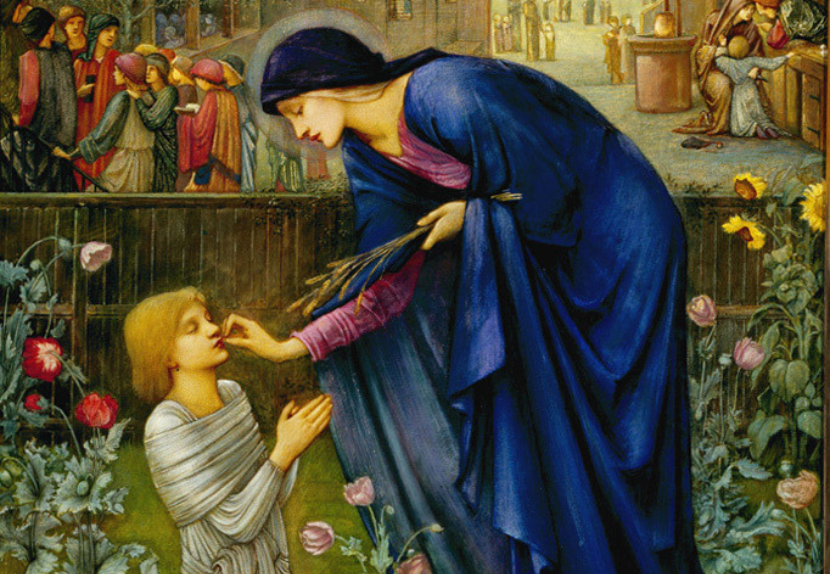
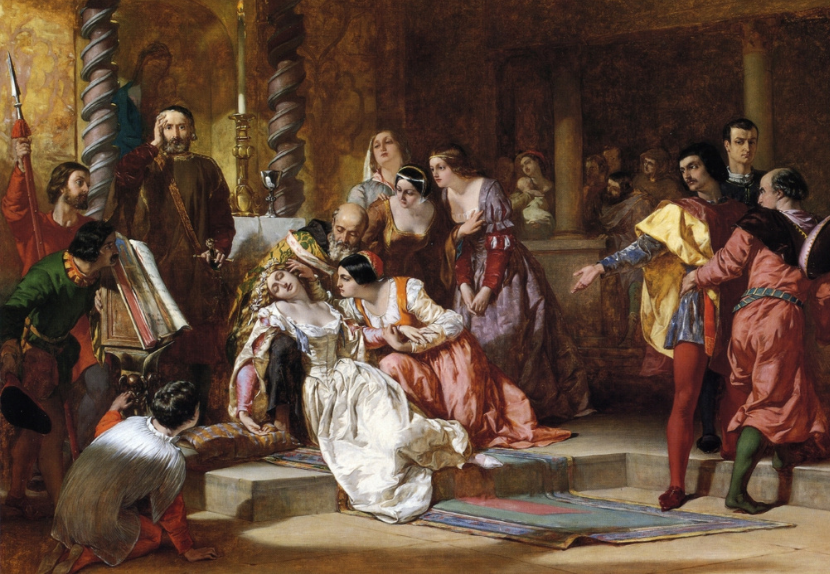
ONLINE THEATER HISTORY COURSE
“A Quartet of Italian and English Literary Genius Plays on in America: Dante, Boccaccio, Chaucer, and Shakespeare”
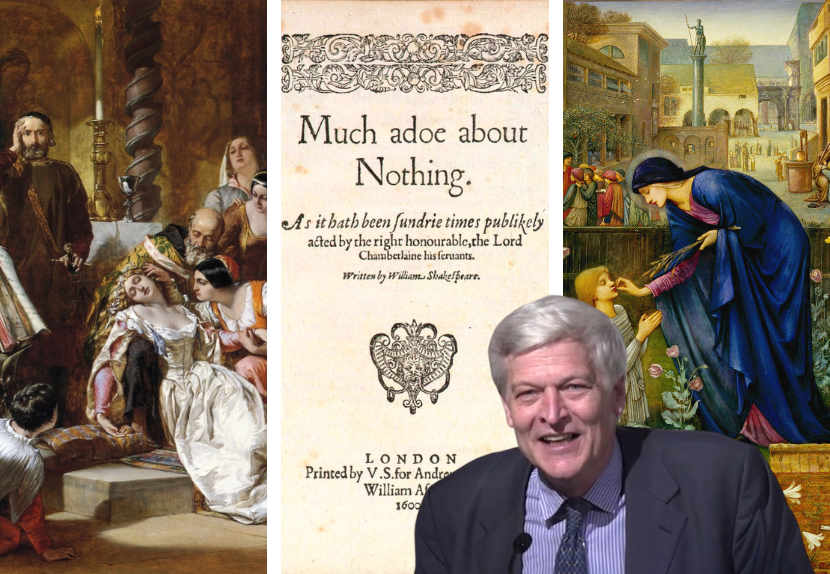
LIVE THEATER HISTORY COURSE with Dr. Eric Nicholson
Dates: January 13, 20 & 27, 2027
Schedule: Wednesdays
Time: 2:00 – 3:15pm ET | 11:00am – 12:15pm PT |
7:00 – 8:15pm London
Contact Hours: 3 Hours 45 Minutes
ONLINE THEATER HISTORY COURSE “A Quartet of Italian and English Literary Genius Plays on in America: Dante, Boccaccio, Chaucer, and Shakespeare“
Course Description:
This course’s three installments will focus first on Dante and Boccaccio as respective masters of Divine and Human Comedy, then on Chaucer’s engagement with Italian culture and literature as guided by Dante and Boccaccio, and finally on these authors’ roles in the making of Shakespeare’s Worlds of Comedy. Throughout, we will encounter and discuss the receptions, adaptations, and performances of these four authors’ writings in the United States, from the nineteenth century to the present, not only in translations and teaching editions, but also in popular films, musicals, documentaries, graphic novels, video games, and online media. A primary aim is to demonstrate how innovative, challenging, and instructive the works of this quartet of literary genius were and still are, inviting us in the 21st century to listen attentively to their voices, as well as to those of their characters.
Virtual Classroom: Full access to an online educational platform with videos of recordings, syllabus, and reading list
Location: LIVE INTERACTIVE ON-LINE THEATER LECTURES
Optional Readings: Information will be provided 2 weeks before the start of the course
Complete syllabus will be provided upon registration.
LECTURE 1 – “Dante and Boccaccio: Italian Masters of Comedy, Divine and Human”
– Wednesday, January 13, 2027
“Nel mezzo del cammin di nostra vita/ mi ritrovai per una selva oscura”; “In the middle of the journey of our life/ I came to myself in a dark wood”: one of literature’s most famous opening lines introduces its author’s mid-life crisis. Almost miraculously, his trauma will resolve itself into a Happy Ending, as Dante the Christian epic hero ascends to the highest Heaven after descending to the depths of Hell and climbing the steep island-mountain of Purgatory. His culminating bliss fulfills the agenda of Comedy and justifies the title of Dante’s great poem, which eventually was granted the status of “Divine” both for its inspired excellence and its setting in the afterlife. In 100 Cantos—today they could be called installments or episodes—composed of three-line “terza rima” stanzas, the trilogy of Inferno, Purgatorio, and Paradisonarrates in the first person its protagonist’s sometimes terrifying, sometimes purifying, and always arduous pilgrimage through worlds beyond ordinary human experience. In deliberate contrast, Boccaccio’s Decameron, written in prose, consists of 100 novelle (short stories), told not by one single autobiographical narrator but by seven young women and three young men. Almost all their tales are set not in the afterlife but in the earthly late medieval real world, making Boccaccio’s anthology a truly Human Comedy. Not by chance its first words are “Umana cosa è…,” literally “A Human thing it is…”
This first lecture of the seminar series thus will focus on the two types of Comedy that Dante’s and Boccaccio’s masterworks would come to represent, and how these general associations would shape their reception in the English-speaking world. While looking ahead and giving a preview of Chaucer’s multiple uses of the two Italian authors’ writings in his own diverse literary efforts, my talk will also explain how a crucial and indeed shared linguistic strategy of The Divine Comedy and the Decameron (and other works by Boccaccio, such as Il Filocolo) provided an inspiring, game-changing model for authors not only across the English Channel but also the Atlantic Ocean.
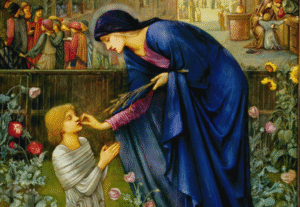
LECTURE 2 – “Chaucer Goes Italian, with Dante and Boccaccio as his Guides”
– Wednesday, January 20, 2027
If Giovanni Boccaccio’s engagement with Dante’s writing would forever shape his own works, and even the stages of his own life—in his final years he was commissioned to give public lectures on The Divine Comedy, and he died with pen in hand, writing a commentary on Canto XVII of the _Inferno—_Geoffrey Chaucer’s encounter with the works of his two illustrious Italian predecessors just as profoundly transformed his own poetic ideas, techniques, and career**.** In a way, the man who would become the first major, still immensely influential English author was destined from birth to “go Italian,” and to transport literary productions from Italy to London and its own emerging vernacular culture. The son and heir of a prosperous family of wine importers, Chaucer grew up near the banks of the Thames river, in a cosmopolitan part of the capital city frequented by Italian entrepreneurs and bankers. Thus, in his youth he probably learned their language, enabling him in 1372-3 to accompany two London-based Italian merchants on an embassy from King Edward III to Genoa.
On this same journey, Chaucer traveled as far as Florence, where he might have met Boccaccio in person, and certainly became familiar with his writings as well as those of Dante and the greatest Italian lyric poet of the time, Petrarch. As this lecture will explain, upon his return home the English author produced his first major achievements, among them _The House of Fame—_a lengthy and provocative engagement with Dante’s Divine Comedy—and the narrative poem Troilus and Criseyde, a translation/transformation of Boccaccio’s Filostrato.
LECTURE 3 – “Shakespeare’s Italian Worlds of Comedy”
– Wednesday, January 27, 2027
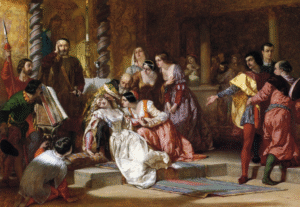
Time and again, in similar as well as contrasting ways, Dante’s and Boccaccio’s comedies reaffirm the triumph of the life principle over death threats of all kinds: Chaucer the poet/pilgrim understands this fact, and if any later author pursues the same agenda, it is Shakespeare. And like his Italian literary forebears, he does so by portraying and celebrating the wit, courage, and perseverance of women. The third and final lecture of the seminar aims to demonstrate these points by focusing on three comedies from different stages of the English playwright’s career—Much Ado About Nothing, All’s Well That Ends Well, and _Cymbeline—_all three set partially or entirely in Italy, all three indebted to Dante and Boccaccio, and all three featuring dynamic female protagonists who overcome misogynistic abuse and false accusations to come back from “hell” or “the dead,” regain and redeem their wayward male partners, and thus bring about happy endings. As we will see, Shakespeare’s worlds of comedy are vibrantly Italian ones, not only for their atmosphere and plot lines, but especially because they employ and transform the devices of creative invention and dramatic re-invention—in short, the ingenious “ingegno”—that have stimulated readers and adapters of The Divine Comedy and the Decameron for over 650 years. As the seminar concludes, we also will consider how our “genius quartet” of medieval/Renaissance Italian and English writers and their works are actually alive and well today in North American media and popular culture, still influencing readers, audiences, and users of graphic novels, musicals, Shakespeare festivals, television series, video games, and a variety of other productions.
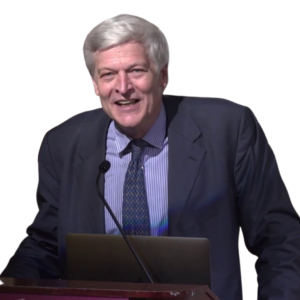
For the past twenty years, Eric Nicholson (Ph.D., Yale University) has been teaching courses in literature and theatre studies at Syracuse University Florence, and at New York University, Florence. At both these venues and elsewhere, he has also directed numerous productions of classic plays, among them Shakespeare’s A Midsummer Night’s Dream, Much Ado About Nothing, and The Tempest. Beyond lecturing, directing, and publishing widely in his field, Eric’s professional activity extends to acting, voice work, and public presentation: credits include Oberon in the Maggio Musicale Fiorentino production of Purcell’s Fairy Queen (Teatro Goldoni Florence, 2013), and Fool/Theseus in “Promised Endings: an Experimental Work-in-Progress based on Oedipus at Colonus and King Lear” (Verona, 2018). He is the narrator of the English video documentary for the Museo dell’Opera del Duomo, Firenze, and of English audio guides to museums in the Tuscan cities of Grosseto, and Massa Marittima. In full historical costume, he has appeared as Lorenzo the Magnificent, Leonardo da Vinci, and others in several live performance events, videos, and broadcasts, and most recently (2021) as Dante and Boccaccio for Rocky Ruggiero: Making Art and History Come to Life.