On-Line/Live Event
ONLINE ART HISTORY COURSE | “Chisel & Brush: Making Italian Renaissance Masterpieces” with Dr. Sally J. Corne...
March 25, 2026
3 weeks
$125.00
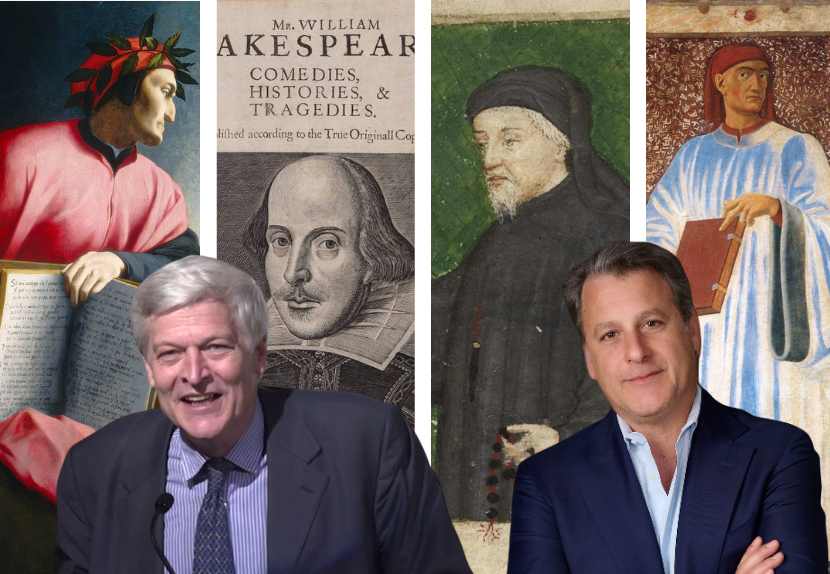
EXCLUSIVE WEBINAR “When We Read Chaucer and Shakespeare We’re Also Reading Dante and Boccaccio”
Presented by Dr. Eric Nicholson
with Additional Commentary by Dr. Rocky Ruggiero
Date & Time:
Thursday, January 15, 2026
2:00 – 3:00pm ET | 11:00am – 12:00pm PT |
7:00 – 8:00pm London
EXCLUSIVE WEBINAR | “When We Read Chaucer and Shakespeare We’re Also Reading Dante and Boccaccio”
Presented by Dr. Eric Nicholson
with Additional Commentary by Dr. Rocky Ruggiero
This special webinar aims to show that if one reads not only between but behind and even within the lines penned by Geoffrey Chaucer and William Shakespeare, one will often encounter the writings of their precursors Dante Alighieri and Giovanni Boccaccio. Chaucer, in fact, wrote two long poems that engage with and emulate entire works by the Italian authors: his “House of Fame” is a response to Dante’s Divine Comedy, and his “Troilus and Criseyde” is based on Boccaccio’s Filostrato. The fourteenth-century English poet admired Dante so much that he imports lengthy passages from “Inferno” and “Paradiso” into several of his Canterbury Tales and their Prologues, including Saint Bernard’s prayer to the Virgin Mary (Paradiso XXXIII): with his full command of Italian, Chaucer knew these verses by heart. Meanwhile, the tale-telling Monk, as he concludes his version of Count Ugolino of Pisa’s tragic story, gives the advice “Redeth the grete poete of Ytaille/ That highte Dant, for he kan all devyse/ Fro point to point; nat o word wol he faille” (“Read the great poet of Italy/ Named Dante, for he can narrate all/ From point to point; not one word will he get wrong”). Chaucer travelled to Italy, where he may even have met Boccaccio, but there is no doubt that he drew inspiration and specific material from the Italian author’s anthology of 100 novelle: a notable example is the Clerk’s Tale, an adaptation of probably the most provocative and hotly debated Decameron story, that of “Patient Griselda” and her tyrannical husband Gualtieri. Although Dante was less of an influence on Shakespeare, the comedy “Much Ado About Nothing” does feature a charismatic leading lady named Beatrice who quips that she has been to the gates of hell, where she was told to get herself to heaven. “The Decameron”, on the other hand, shapes several Shakespearean plays featuring other brilliant and courageous women, most especially “All’s Well That Ends Well”, set partially in Florence and based on the story of Giletta di Narbona, and Cymbeline,with its Italianate characters and plot derived from the story of Ginevra, Bernabò, and Ambrogiuolo. Just as importantly, the innovative poetic as well as prose techniques and the vast range of complex ideas explored in the two Italian writers’ masterpieces crucially enabled Chaucer and Shakespeare to create their own English classics.
The webinar will include a 45-minute lecture followed by 15-minutes of Q&A.
Please note:
For the past twenty years, Eric Nicholson (Ph.D., Yale University) has been teaching courses in literature and theatre studies at Syracuse University Florence, and at New York University, Florence. At both these venues and elsewhere, he has also directed numerous productions of classic plays, among them Shakespeare’s A Midsummer Night’s Dream, Much Ado About Nothing, and The Tempest. Beyond lecturing, directing, and publishing widely in his field, Eric’s professional activity extends to acting, voice work, and public presentation: credits include Oberon in the Maggio Musicale Fiorentino production of Purcell’s Fairy Queen (Teatro Goldoni Florence, 2013), and Fool/Theseus in “Promised Endings: an Experimental Work-in-Progress based on Oedipus at Colonus and King Lear” (Verona, 2018). He is the narrator of the English video documentary for the Museo dell’Opera del Duomo, Firenze, and of English audio guides to museums in the Tuscan cities of Grosseto, and Massa Marittima. In full historical costume, he has appeared as Lorenzo the Magnificent, Leonardo da Vinci, and others in several live performance events, videos, and broadcasts, and most recently (2021) as Dante and Boccaccio for Making Art and History Come to Life. This past June, Eric led the Making Art and History Comed to Life seminar on “Shakespearean Comedy, Italian Style.”